Artificial intelligence is everywhere right now — from chatbots to image generators to property platforms offering instant room styling at the click of a button. With tools promising “designed in seconds,” it’s easy to wonder whether human expertise is becoming optional.
But when it comes to designing spaces for real life, AI still falls short.
At its best, AI is excellent at producing images. At its worst, it confuses appearance with understanding. And in design, that difference matters.
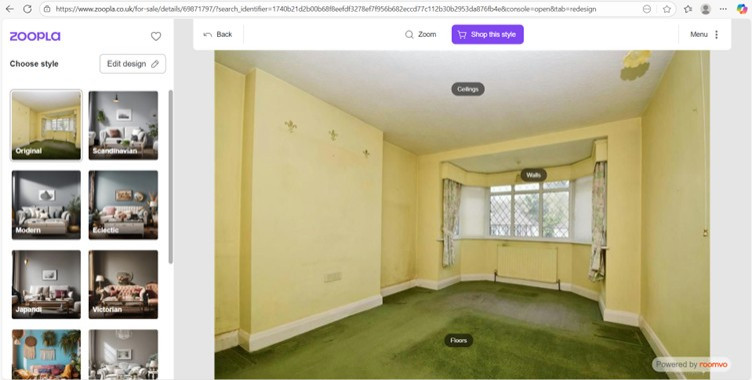
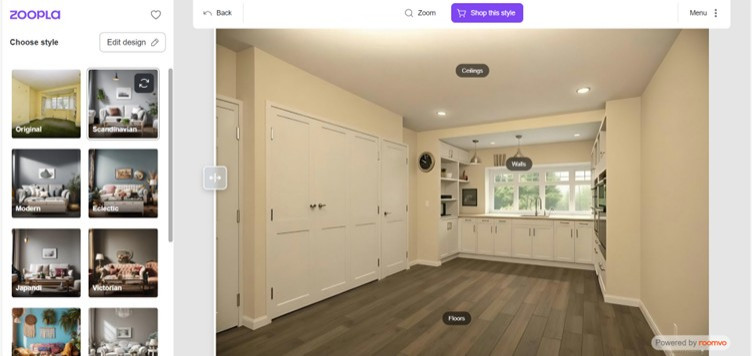
Zoopla AI screenshots
The problem with “perfect on screen” design
We’ve seen AI-generated room suggestions that look striking online… Clean lines. On-trend colours. Perfectly styled furniture.
But look a little closer and the cracks appear.
Beautiful compositions that make no sense once you imagine actually moving through the space.
That’s because AI doesn’t understand context. It doesn’t grasp how a home functions, how people move, or how spaces need to work together. It doesn’t understand where sunlight hits the breakfast table, proportion, comfort, or the subtle balance between beauty and function. These tools are fun for quick visualisation, they can replicate patterns, but they miss the core of what makes a home work — the human experience.
HOMES ARE LIVED IN, NOT RENDERED
A home isn’t just a collection of rooms. It’s a series of experiences that unfold throughout the day.
Morning light at the breakfast table. Quiet corners when the house is busy. Clear pathways when children are running through the space. The way sound travels, how storage is used, where clutter naturally accumulates.
These are things AI can’t “see.”
Design requires understanding how people live, not just how a room looks. It’s about balancing beauty with comfort, flow, and practicality — and knowing which compromises matter and which don’t.
Studio JKL project, photographed by Anna Stathaki
The Limits of Data-Driven Design
AI works by analysing existing data and producing variations
based on what already exists. That makes it great for inspiration and visual exploration — but poor at originality, problem-solving, and foresight.
It doesn’t anticipate future needs.
It doesn’t question whether a layout makes sense.
It doesn’t understand emotional response or wellbeing.
And when design decisions go wrong, the consequences aren’t
digital — they’re physical and expensive. Poor layouts, awkward lighting, inefficient circulation and impractical storage can’t be fixed with a new cushion or paint colour.
That’s where professional expertise pays for itself.
Our process considers both the big picture and the small details
— from architectural flow and zoning to joinery and lighting placement, ensuring that every design decision works in harmony.
Where AI Fits — and Where It Doesn’t
AI can be a useful assistant. It can help spark ideas, visualise styles, or speed up early-stage exploration. Used thoughtfully, it’s a helpful tool in the creative process.
But tools don’t replace judgement.
Design still relies on human insight: interpreting needs, reading between the lines, and making decisions based on experience rather than algorithms. It’s about knowing when to follow rules — and when to break them.
AI can show you what a space might look like.
A designer shows you how it will feel to live in.
Ai Pinterest image: source unknown
Image Source: Matter Group Instagram
Why human expertise still matters
Design is about more than data — it’s about intuition,
collaboration, and foresight. The best spaces tell a story about the people who live there. They grow, evolve, and adapt with you. Great design isn’t just about how a space looks on day one. It’s about how it performs over time.
Human expertise brings:
Intuition built through experience
Understanding of space, proportion, and flow
Empathy for how people actually live
The ability to adapt, refine, and problem-solve
AI can generate an image.
A human designer shapes an environment.
Studio JKL project, photographed by Anna Yanovski
The Bottom Line
AI is powerful, impressive, and here to stay. But it isn’t a replacement for human expertise.
Homes are deeply personal. They reflect routines, relationships, habits, and emotions — things no algorithm can fully understand.
When it comes to creating spaces that truly work, human thinking isn’t optional. It’s essential.
At Studio JKL, we don’t design for algorithms — we design for people. If you’re planning a renovation and want your home to work as beautifully as it looks, explore our service packages or book a complimentary consultation.